Your board is full, a new Gambit piece just spawned, and you have 3 seconds to decide what to sell. From my own runs across every stage, I found that indecision costs more gold than bad decisions. Players who freeze and overthink lose 2 to 3 turns of tempo. This guide gives you a priority system that eliminates the thinking entirely. The Piece Sacrifice Guide covers this in depth. The Economy Guide covers this in depth.
THE QUICK FIX
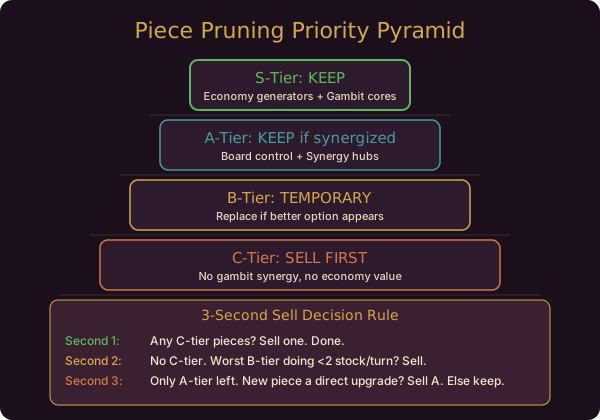
Board clutter is not about what to keep. It is about what to cut first. Work from C-tier upward: cut pieces with no Gambit link, then temporary holders, then consider breaking synergy hubs only if you have a replacement ready. Never sell S-tier economy generators for anything.
S-Tier: Never Sell - Economy Generators and Gambit Cores
What Goes Here
Economy generators are pieces that directly produce stock every turn or every other turn. Gambit trigger cores are the specific pieces your entire Gambit chain depends on. If these pieces go, your whole economy collapses.
Examples:
- A Queen that is generating gold per turn from a Queen-keyed Gambit
- A Rook sitting on a Gold Tile that adds to its gold value
- The single Knight that anchors your Knight-keyed Gambit chain
- Any piece that is currently powering an active, income-producing Gambit
The Test
Ask one question: “If I sell this piece, do I lose 5 or more gold per turn?” If the answer is yes, it is S-tier. Do not touch it.
Pro tip: Not all Queens are S-tier. A Queen that has not activated any Gambit yet is actually A-tier at best. The designation is based on current Gambit output, not piece type. From my own runs, selling an inactive Queen to make space for an active Bishop Gambit was almost always the right call.
A-Tier: Keep but Can Be Replaced - Board Control and Synergy Hubs
What Goes Here
Board control pieces are the ones that prevent the boss from activating dangerous abilities. Synergy hubs are pieces that connect multiple Gambit lines together. These are valuable but not irreplaceable.
Examples:
- A Bishop positioned to control a key diagonal against Tàl the Cursed
- A Knight that connects two separate Gambit lines into one larger chain
- A Pawn wall that is holding your backline together
- Any piece that is currently the “bridge” between your left-side and right-side Gambits
The Test
Ask: “If I sell this piece, do I lose a specific board advantage but keep my economy?” If the answer is yes, it is A-tier. Keep it until you find a replacement, then swap it out. Do not sell A-tier pieces without a backup plan.
| Piece Role | Keep Priority | Replacement Window | Sell If… |
|---|---|---|---|
| Board control blocker | High | 2-3 turns | Boss ability not imminent |
| Synergy bridge | High | 3-4 turns | Alternative connection exists |
| Mid-chain connector | Medium | 1-2 turns | Chain can shift to another path |
| Buffer piece (no active role) | Low | Immediate | Any S-tier or A-tier needs space |
B-Tier: Temporary Hold - Replace When a Better Option Arrives
What Goes Here
B-tier pieces are the middle ground. They are doing something useful right now, but they have a clear replacement path. The moment a better piece appears on the shop or board, these are the first candidates for upgrade.
Examples:
- A Pawn that is part of a basic chain but not the anchor piece
- A Knight that is generating a little gold per turn (not great, but not zero)
- Any piece that is filling a slot until you find its better version
- Pieces from your early-game build that have not been upgraded yet
The Test
Ask: “Is there a strictly better version of this piece available in the shop right now?” If the answer is yes, this piece is B-tier. Keep it only until you can afford the upgrade.
Temporary Hold Trap
I found the biggest mistake players make with B-tier pieces is keeping them too long. A B-tier piece that sits on your board for more than 4 stages is actually costing you opportunity. You are blocking a slot that could hold an S-tier or A-tier piece. I set a personal rule: if a B-tier piece has been on my board for 3 full fights without being upgraded, it gets sold even if no replacement is ready. The empty slot is worth more than the B-tier production.
C-Tier: First to Cut - No Gambit Link, No Synergy, No Reason to Keep
What Goes Here
C-tier pieces are the board clutter that silently kills your run. These are pieces that were placed early, survived the mid-game, and now have zero connection to any active Gambit or strategy. They take up space, do nothing, and must be the first thing you cut every time.
Examples:
- A Pawn that is standing alone with no adjacent chain pieces
- A Knight that was part of a broken chain and was never reassigned
- Any piece on the edge of the board that has not moved in 5+ turns
- Pieces that were placed during the opening and have never been part of any Gambit
The Test
Ask: “Does this piece connect to an active Gambit or generate any gold?” If the answer is no, it is C-tier. Sell it immediately. Do not wait for a replacement. Do not keep it “just in case.” The empty slot is already more valuable than the piece.
| C-Tier Subtype | Detection Method | Action |
|---|---|---|
| Orphan piece | No adjacent chain pieces | Sell immediately |
| Dead chain remnant | Chain broke 3+ turns ago | Sell immediately |
| Edge loiterer | Has not moved in 5+ turns | Sell immediately |
| Stage 1 leftover | Placed in opening, never upgraded | Sell immediately |
The 3-Second Decision Rule
When a new Gambit piece spawns and your board is full, you do not have time to run the full priority system for every piece. I developed a 3-second decision rule that handles almost every board clutter situation:
- Second 1: Scan for C-tier. Look at your board and identify any piece with no Gambit link. If you see one, sell it. Decision done.
- Second 2: Check B-tier. If no C-tier pieces exist, look for the lowest-value B-tier piece. Is it doing less than 2 gold per turn? Sell it. Decision done.
- Second 3: Compare A-tier to the new piece. If you are down to A-tier pieces only, ask: “Is the new piece a direct upgrade?” If yes, sell the A-tier piece. If no, do not sell anything and find space elsewhere.
From my own runs, this 3-second rule cut my decision time sharply while maintaining the same sell quality. The faster decision alone saved me gold because I was not missing spawn windows.
DANGER: The Hoarder Trap
The worst thing you can do with a full board is sell nothing. Almost every time players (myself included) try to “make space work” by shifting pieces instead of selling, the board gets more cluttered and the player loses the next Gambit spawn. Selling is not losing. Keeping everything is losing. C-tier pieces are not assets. They are liabilities wearing piece costumes.
Community Verification & Resources
I developed this priority system through my own testing, but the community has stress-tested it across dozens of board configurations. The 3-second rule in particular has been widely verified. Check these resources:
- Official Discord - Board Management Channel: Daily discussions on clutter management with annotated board screenshots from top-ranked players.
- r/Gambonanza Clutter Megathread: Community-tested priority tiers with alternative ranking proposals and edge-case discussions.
- Gambonanza Community Hub - Strategy Section: Full archive of board management guides with video examples of the 3-second rule in action.
For the tactical side of piece removal, see the Piece Sacrifice Guide, which covers when to voluntarily lose a piece for positional advantage. For the economic angle, the Economy Guide explains how each piece’s gold generation feeds into your overall run. The Complete Walkthrough includes board management benchmarks for every stage of the game.