Gambonanza gates its difficulty behind progress. Finish a run once, and the higher tiers open up in sequence. Each one stacks negative modifiers on top of the last.
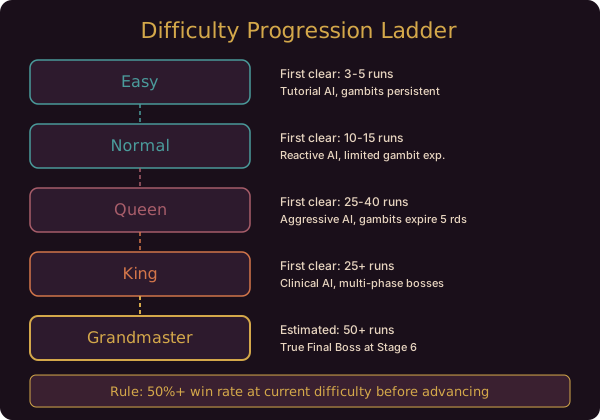
How the Difficulty System Works
| Stage | State | What changes |
|---|---|---|
| First runs | Default tier | Learn the board, Gambit triggers, and the boss preview |
| After first clear | Tiers unlock | Six tiers open in order, named after chess pieces starting with Rook and Knight |
| Higher tiers | Stacked modifiers | Each tier adds negative modifiers that constrain your run |
| Top tiers | Hidden content | An extra boss appears beyond the standard 8-boss roster |
The Base Game, Before Any Difficulty
Before modifiers enter the picture, every run has the same shape:
- A 5x5 board with 3 pieces, growing by a row after each stage you clear
- 5 stages of 5 games, with a boss every 5th game
- 8 real bosses with randomized order
- The Stalemate Counter (3/3 ends a game) and Crumble pressure from turn one
Get comfortable here first. Difficulty is not harder board geometry, it is more pressure on the same systems.
What Higher Tiers Add
Higher tiers do not change the rules, they narrow your margin for error.
| Pressure source | How it shows up at higher tiers |
|---|---|
| Negative modifiers | Each tier stacks a modifier that works against you |
| Tighter economy | Less room to buy your way out of a bad boss matchup |
| Harder bosses | The same 8 bosses, but their modifiers bite more |
| An extra boss | The top tiers hide a 6th boss beyond the standard roster |
General Advice for Higher Tiers
- Prep for the boss preview, always. At high tiers, buying the wrong thing is the difference between a clear and a wipe.
- Keep a buffer. Without spare gold, one bad boss game ends the run.
- Match Gambits to your board. A cheap Gambit you trigger every game beats an expensive one that never fires.
- Protect your best piece. A piece lost in a boss fight is gone for the rest of the run.
- Watch both counters. Crumble and the Stalemate Counter punish slow play more at high tiers.
Books and Badges
If you are chasing completion, the Collection covers roughly 200 entries across six categories (Gambits, Pieces, Tiles, Enemy Modifiers, Bosses, Strains), and the game ships with 53 Steam achievements. Climbing difficulties and filling the Collection go hand in hand: the harder tiers are where the rare entries and challenge milestones live.
Progression Checklist
Before you move to the next tier, check:
- Can you clear the current tier consistently?
- Do you read the boss preview before every shop?
- Do you keep a gold buffer into boss games?
- Can you name what each of the 8 bosses does to your board?
- Do you know which Gambits your board actually triggers?
If yes across the board, the next tier is ready.
The highest tier changes more than the modifier list suggests, because it also hides an extra boss behind the usual roster. The King difficulty hidden changes guide covers what only appears once you are there.
Related Guides
- Complete Walkthrough - A full run start to finish
- Beginner Guide - The basics
- Boss Battle Guide - All 8 bosses and their modifiers
- Economy Guide - Keeping a buffer