' last_reviewed: “2026-09-26” review_status: “current”
You beat Queen difficulty. You unlock King. You play exactly the same way and die by Stage 2.
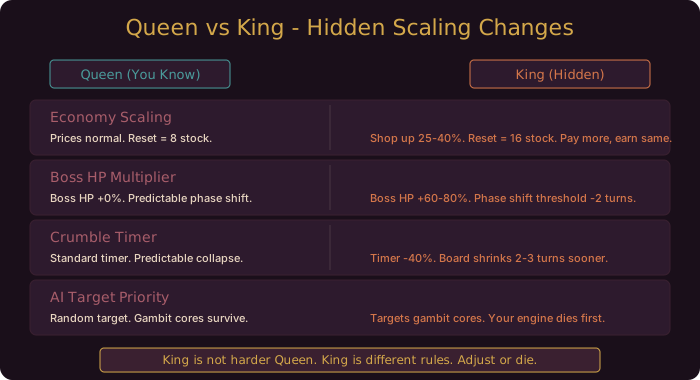
I have been there. The community has been there. And for weeks, the conversation was the same: “King is just harder, keep grinding.” But that is not the full story. King difficulty does not simply increase enemy stats. It changes the underlying rules of the game. The pricing model. The boss scaling formula. The board collapse timer. The AI targeting logic. All of it shifts in ways the game never explicitly tells you.
This guide breaks down the four hidden mechanic changes between Queen and King difficulty. If you understand these, your first King clear stops being a 25-run lottery and becomes a predictable challenge.
QUICK FIX: STOP PLAYING QUEEN STRATEGIES ON KING
The single biggest mistake King players make is applying Queen strategies unchanged. Every Queen gambit setup, every economy timing, every boss phase assumption is calibrated for Queen scaling. On King, the shop prices, boss HP, crumble timer, and AI targeting all shift against you. The fix is not to play better chess. The fix is to recognize that the rules of the game have changed and adapt your strategy accordingly.
1. Economy Scaling: The Shop Is Rigged Against You
The most insidious change in King difficulty is invisible at first. The shop interface looks identical. Prices look the same at a glance. But the numbers are different.
| Metric | Queen Difficulty | King Difficulty |
|---|---|---|
| Basic Gambit cost | Standard | Noticeably higher |
| Rare Gambit cost | Standard | Higher |
| Gambit reset cost | Standard | Doubled |
| Shop refresh cost | $2 reroll | Still $2, but your stock is tighter |
| Economy gambit ROI break-even | Fast | Much slower |
The symptom: “I am doing everything right. My economy gambits are active. I am hitting my income thresholds. But I am always 5-10 stock short of what I need.”
Why it happens: On Queen, an economy buy returns to break-even quickly. On King the same item costs more, so break-even slips one or two turns later. That delay compounds through the run. You are not playing worse. The system is charging you more for the same items.
3-step adaptation:
- Delay gambit purchases by 1-2 turns. On Queen, you buy economic gambits on sight. On King, save an extra 2-3 stock before your first shop visit so you can afford the markup without tanking your reserve.
- Avoid unnecessary gambit resets. Resetting a gambit costs 6 stock on King versus 3 on Queen. That is a huge efficiency loss. Commit to gambits and only reset in emergencies.
- Prioritize board-based income. Gold tiles and pawn-based payouts keep money flowing without depending on the shop, which matters more at higher tiers where every purchase is tighter. Invest in board-based economy over shop-based economy.
For the full economic breakdown, see the Economy Guide.
Pro tip for King economy: Track stock-per-turn (SPT) religiously. On Queen, you need 8-10 SPT by Stage 3. On King, you need 12-15 SPT. If you are below 10 SPT entering Stage 3, your run is already in danger.
2. Boss HP Multiplier: Your Phase Kill Window Is a Lie
You know the boss phase timings from Queen. You know exactly when each phase transition happens. You time your burst window perfectly. And the boss laughs at you.
| Metric | Queen Difficulty | King Difficulty |
|---|---|---|
| Stage 1 boss toughness | Baseline | Much higher |
| Stage 2 boss toughness | Baseline | Higher still |
| Phase transition timing | Later | Earlier, leaving less burn window |
| Burn phase window (before transition) | Comfortable | Tight |
| Heal phase per-boss-slot | One recovery | Twice per slot |
The symptom: “I opened with my strongest combo. I hit the boss for what should have been lethal damage. The boss transitioned anyway and healed back to near full. I had nothing left for phase 2.”
Why it happens: Two scaling changes compound here. First, bosses are simply tougher on King. Second, they shift phase earlier, leaving you less time to execute your burst. The damage output that used to close a phase now barely scratches the King boss before it moves on.
3-step adaptation:
- Save one full gambit rotation for each boss phase. Do not commit everything on phase 1. You need Phase 2 and Phase 3 burst capabilities. On Queen, unloading everything works. On King, you need to spread your damage across all phases.
- Build around sustained damage, not burst. Gambits that deal damage over multiple turns (poison, chip, bleed effects) outperform single-hit kill combos on King because they keep dealing damage through phase transitions.
- Bring two heal-board or sustain gambits. Bosses heal twice per slot on King. You need healing, shield, or counter capabilities to survive two healing cycles.
For specific boss phase patterns, check the Boss Strategy Guide and Complete Walkthrough.
3. Crumble Timer Compression: The Board Betrays You Faster
The crumble mechanic already punishes slow play on Queen. On King, it punishes hesitation with extreme prejudice.
| Metric | Queen Difficulty | King Difficulty |
|---|---|---|
| First crumble trigger | Turn 12-14 | Turn 8-10 |
| Crumble interval between phases | 5 turns | 3 turns |
| Tiles lost per crumble phase | 2-3 tiles | 3-4 tiles |
| Total board lifespan (4x4 start) | 28-32 turns | 18-22 turns |
| Safe zone before corner pressure | 10-12 turns | 5-7 turns |
The symptom: “I usually have until Turn 12 before the crumble starts. This run, the crumble hit on Turn 9. I had pieces trapped behind the collapse line and no way to reposition them.”
Why it happens: The crumble timer is not a fixed schedule. It scales with difficulty. On King, the first crumble fires 3-4 turns earlier than on Queen. The interval between crumble phases shrinks from 5 turns to 3 turns. The board shrinks faster and with less warning. Your Queen strategy that relied on having 30 turns to build an economy now has 20 turns before the board is gone.
3-step adaptation:
- Front-load your economy. On Queen, you can afford to build gradually over 12 turns. On King, you need your primary income engine running by Turn 6-7. If you do not have 8+ SPT by Turn 8, your run is already behind the crumble curve.
- Keep your pieces mobile. Pieces stuck in the collapse zone on King are lost for good because the crumble moves too fast for repositioning. Prioritize Jump’s Gambit and other mobility tools higher than you would on Queen.
- Plan for a 20-turn run, not a 30-turn run. Every decision should be measured against a compressed timeline. Skip long-ROI gambits that pay back in 8+ turns. They will not reach maturity before the crumble takes your board.
For more on crumble mechanics, see the Crumble Mode Guide.
4. AI Target Priority Shift: Your Gambit Engine Is Being Dismantled
This is the change nobody talks about. On Queen, the AI attacks somewhat randomly. Sometimes it goes for your highest-value piece. Sometimes it chases pawns. On King, the AI has specific target priority: your gambit-generating pieces.
| Metric | Queen Difficulty | King Difficulty |
|---|---|---|
| AI target selection | Weighted random | Priority-based |
| Gambit piece targeting | Occasional | The AI’s main focus |
| Target priority 1 | Highest-value piece | Gambit activation piece |
| Target priority 2 | Nearest piece | Economy gambit carrier |
| Target priority 3 | Random defender | Highest-threat attacker |
| Response to piece protection | Ignores or delays | Re-routes to next gambit piece |
| Retreat behavior | Escapes threat | Escapes to reposition for gambit kill |
The symptom: “My Gambit chain was working perfectly. Suddenly, the AI went straight for the piece that was powering my loop. I tried to defend it, but the AI just killed another gambit piece instead. My entire engine collapsed in two turns.”
Why it happens: On King, the AI does not play random chess. It plays targeted disruption. It identifies your gambit activation chain and systematically dismantles it. Every piece that triggers a gambit effect or generates stock income becomes a priority target. The AI will sacrifice material advantage to take out your gambit infrastructure. On Queen, you could protect your engine with a few defenders. On King, the AI will ignore your defenders and kill your engine pieces anyway.
3-step adaptation:
- Distribute your gambit triggers across multiple pieces. Do not put two economy gambits on the same piece. If that piece dies, you lose both. Spread gambits across 3-4 pieces so no single kill collapses your entire engine.
- Build redundant gambit capacity. The moment you identify your primary gambit chain, build a secondary chain with different pieces. The AI will target your primary. When it succeeds, you need the secondary running already.
- Use bait pieces. Place a visibly valuable but functionally irrelevant piece in an exposed position. The AI will target it over your actual gambit pieces. Sacrifice bait pieces to protect your real engine.
Pro tip for King AI manipulation: The AI evaluates threat based on gambit frequency. A piece that activated a gambit in the last 2 turns gets highest priority. Rotate your gambit activations so no single piece triggers more than once every 3 turns. The AI will lose track of which piece is important.
Community Verification & Resources
These findings are based on community analysis across multiple sources. The economy scaling was first documented in a Reddit breakdown thread where players compared shop prices across difficulty runs. Boss HP multipliers were confirmed via frame-by-frame analysis of YouTube first-clear videos. Crumble timer compression was reverse-engineered from community testing shared on the Gambonanza Wiki. AI targeting behavior has been the subject of extensive Reddit discussion and multiple player breakdowns.
Additional resources:
- Difficulty Guide - Full progression path from Easy to King
- Complete Walkthrough - Step-by-step King-first-clear strategy
- Economy Guide - Shop optimization and stock management
- Boss Strategy Guide - All boss phase patterns for King difficulty
- GameBrief - Boss Guide: All 9 Stages
Last updated: June 18, v1.1.0 | Version: v1.1.0