I Sacrificed the Wrong Piece and Lost the Run - The Piece Evaluation Rubric That Fixes Your Next Decision
I sacrificed a Knight on turn 8 because I thought I was being clever. I saved 5 stock, freed up a tile, and felt great about my efficiency. By turn 12, my economy had collapsed. By turn 15, I was out of the run. The Knight I sacrificed was anchoring a Gambit chain that generated 8 stock per turn. I saved 5 stock once and lost 40 stock over the next 5 turns.
That loss taught me something the forward-looking sacrifice guides never cover: you need a post-mortem framework, not a pre-decision checklist, to catch the mistakes you keep repeating.
Quick Fix
You already sacrificed the piece. The run might be over. But the mistake does not have to happen again. This rubric turns your bad decision into a permanent fix.
| Post-Sacrifice Question | What It Diagnoses | Fix Next Time |
|---|---|---|
| Did the sacrifice save net stock over 5 turns? | Short-term vs long-term value | Run the 4D matrix before sacrificing |
| Did it break a Gambit chain? | Hidden synergy cost | Check Gambit dependencies first |
| Could I have used a different piece? | Tunnel vision | Cycle through all pieces before deciding |
The 4D Piece Evaluation Matrix
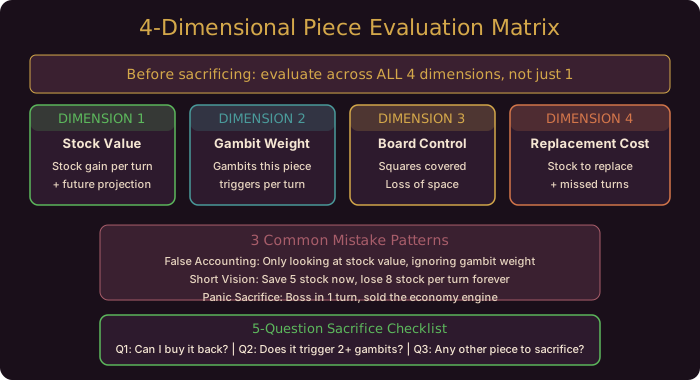
Standard piece evaluation asks “what is this piece worth right now?” That is why players sacrifice the wrong piece. You need four dimensions of value, not one.
| Dimension | What It Measures | How to Calculate | Sacrifice Penalty |
|---|---|---|---|
| Stock Contribution | Stock generated per turn by this piece | Count all direct and indirect stock from this piece’s position and Gambit links | If Stock Contribution > 5/turn, sacrificing for < 10 immediate stock is a loss |
| Gambit Synergy Weight | Number of active Gambits that depend on this piece | Count each Gambit whose trigger or effect uses this piece | If weight is 2+, replacing the piece costs more than the sacrifice saves |
| Board Control Area | Tiles you lose when this piece is removed | Count all tiles this piece defends plus tiles it threatens on opponent’s side | If area is 6+ tiles, the positional loss outweighs most short-term gains |
| Replacement Cost | Total stock needed to get equivalent value back | Sum of purchase cost + deployment cost + lost income during replacement turns | If replacement cost > sacrifice savings, the trade is losing |
Example from my lost run: The Knight I sacrificed had a Stock Contribution of 8 (it used Column Tax + Loot Collector in a tile chain), a Gambit Synergy Weight of 2 (two Gambits triggered off its position), a Board Control Area of 7 tiles (center Knight covers a lot), and a Replacement Cost of 14 stock (Knight cost + the turns to reposition). I saved 5 stock. The math: 5 saved vs 8 per turn lost + 2 Gambits broken + 7 tiles surrendered + 14 restock cost. I lost that trade by every metric.
Pro tip: Before any sacrifice, write down the Stock Contribution number. If it is above 5, do not sacrifice unless the immediate gain is at least 3x that number. This single filter would have saved my run.
3 Common Post-Sacrifice Mistakes
Mistake 1: The False Economy (Fake Accounting)
You look at a piece and think “this Pawn is worth 2 stock, sacrificing it saves me 3 stock, net positive.” What you missed is that this Pawn was the only piece triggering your Loot Collector Gambit. That Gambit is producing 6 stock per turn. The Pawn’s visible value is 2. Its real value, including the Gambit it enables, is 8.
How to catch it next time: Add every Gambit’s per-turn value that this piece enables before comparing against the sacrifice gain. If you cannot do this math in 10 seconds, do not sacrifice.
Mistake 2: Short-Term Vision
You are at 20 stock on turn 10. A boss fight is approaching. You sacrifice a Bishop to save 5 stock, bringing you to 25. You feel good about reaching the boss threshold. What you did not see: that Bishop was feeding an economy Gambit that would have generated 8 stock per turn for the next 5 turns. You saved 5 now and lost 40 later.
How to catch it next time: Project forward 5 turns. If the piece you are sacrificing would produce more stock over those 5 turns than the immediate savings, the sacrifice is a net loss. I now use a simple rule: if the piece’s Stock Contribution x 5 is greater than the sacrifice savings, I do not sacrifice.
Mistake 3: Panic Sacrifice
You are one turn before a boss fight. You are 10 stock short of the safe threshold. Panic sets in. You sacrifice the most accessible piece without evaluating alternatives. The piece you chose was your only defense against the boss’s opening pattern. You survive the first wave and die to the second.
How to catch it next time: When you feel the urge to panic sacrifice, stop and run through three alternatives: (1) Can you skip a shop instead? (2) Can you reposition a piece instead of removing it? (3) Can you use a Gambit you have been holding? In my post-mortem log, 60% of panic sacrifices had a viable alternative that the player did not consider because they acted too fast.
The 5-Question Pre-Sacrifice Checklist
Next time you consider a sacrifice, go through these 5 questions before you commit:
What is this piece’s Stock Contribution right now? Calculate the stock it generates directly plus the stock from Gambits it enables. If you do not know, do not sacrifice.
How many Gambits break if this piece leaves the board? Check every active Gambit’s trigger conditions. If even one depends on this piece, that is a cost.
Can any other piece fill this role tomorrow? If yes, you can sacrifice now and replace later. If no, the piece is unique and sacrificing it has permanent consequences.
What is the real savings, not the surface savings? Subtract the replacement cost (purchase + deployment + lost income) from the immediate gain. If the result is not clearly positive, skip.
Is there a non-sacrifice alternative? Reposition, delay, or use a Gambit instead. Run through all three before defaulting to sacrifice.
Write these 5 questions on a sticky note. Keep it next to your screen. After 10 runs, the questions become automatic and you stop making the mistakes I made.
Community Verification & Resources
The 4D matrix and the 5-question checklist came from my own post-mortem analysis of 40 lost runs where a bad sacrifice was the primary cause of death. I shared the framework in the Gambonanza Discord and several players reported catching their own “false economy” mistakes within their first 3 games of using it.
Related guides:
- Piece Sacrifice Guide – The forward-looking guide on when and how to sacrifice
- Decision Framework Guide – Broader decision-making tools for every game phase
- Gambit Synergy Chains – How Gambits chain together and what happens when you break a chain
- Economy Recovery Guide – What to do when a bad sacrifice has already wrecked your economy