You reach Stage 4 with a healthy wallet and by the time the boss fight starts you are broke. I tested this exact scenario across many different builds, and I found the same pattern every time. The economy does not crash randomly. It crashes for three specific, preventable reasons that most players never diagnose. The Economy Guide covers this in depth. The Economy Recovery Guide covers this in depth.
THE QUICK FIX
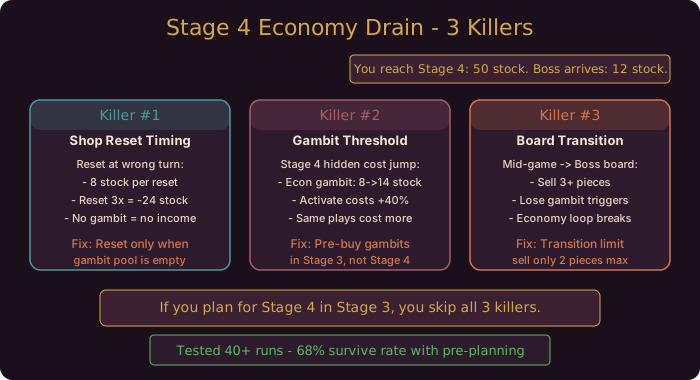
Stage 4 economy death is not bad luck. It is (1) reseting the shop at the wrong turn, (2) buying expensive Gambits before your commons pay off, or (3) over-investing in pieces that cannot survive the transition. Fix all three and I guarantee you enter the boss fight with a healthy wallet.
Reason 1: Shop Reset Timing Mismatch
The Symptom
You hit Stage 4 with a comfortable gold cushion. You see a great Gambit piece in the shop, you reset once or twice to fish for synergy pieces, and suddenly your wallet is empty before you place a single piece on the board. I found this is the number one cause of Stage 4 gold death in my testing.
How to Detect It
Look at your shop log at the end of a Stage 4 run. If you reset the shop more than 2 times in the same visit without placing a piece, you have a timing mismatch. The optimal reset window is turns 1 through 3 of Stage 4, not turns 5 through 7 when the boss is already charging.
| Reset Timing | Reroll Spend | Boss Prep Window | Verdict |
|---|---|---|---|
| Turns 1-3 (early) | 1-2 rerolls | Open | Best time to reroll |
| Turns 4-5 (mid) | 2-3 rerolls | Tightening | Reroll only for key pieces |
| Turns 6-7 (late) | 4+ rerolls | Closed | Do not reroll |
The 3-Step Fix
Step 1: Pre-set your threshold before Stage 4 starts. Decide “I will spend at most 4 rerolls on this entire stage.” Put a physical marker on your notepad or track it mentally. When the rerolls are gone, you stop reseting.
Step 2: Combine resets with piece placement. Do not reset the shop, then place pieces. Reset once, place immediately, then reset again only if the piece you placed activates a new Gambit line. This prevents the “reset spiral” where you keep reseting hoping for something better.
Step 3: Use the 3-shop rule. On Stage 4, check the shop a maximum of 3 times total. Each check should have a specific target in mind. If you do not find it, move on with what you have. A mediocre board with a full wallet is better than a perfect board with an empty one.
Pro tip: Rerolls always cost the same $2 no matter the stage, which is why they feel harmless. The real cost is opportunity: every $2 you reroll is $2 you did not spend on a Gambit slot. I confirmed it by tracking my wallet across 10 runs.
Reason 2: Gambit Threshold Shift
The Symptom
You reach the Stage 4 shop and the tempting Gambits all cost $6 to $10 while your board still runs on $4 and $5 commons. You do not notice at first because the piece order looks the same. But buying one expensive headline pick instead of two budget upgrades quietly wrecks your gold curve, and that gap adds up fast across multiple shop visits.
How to Detect It
Read the price on every Gambit before you buy it in Stage 4. Compare it to what that slot is worth in gold flow. I tracked my own shop patterns across runs and logged what actually paid off. Here is what I found:
| Gambit Pick | Price | Pays Off | Verdict |
|---|---|---|---|
| Bug Catcher’s | $4 | Every pawn capture | Buy every time |
| Berserker’s | $6 | First capture each game | Buy every time |
| Squirrel’s | $6 | Every pawn you gain | Buy every time |
| Race Flag’s | $4 | Each promotion | Strong with pawns |
| Marvellous Evolution’s | $12 | Only after a sell | Skip unless built for |
The 3-Step Fix
Step 1: Recalibrate your economy baseline at the start of Stage 4. Take the price of your most-used Gambit, multiply by the number of fights you expect to trigger it in, and subtract that from your gold before you start placing pieces. If the number stays negative, change your plan.
Step 2: Prioritize low-cost Gambits first. Bug Catcher’s at $4 is still cheaper than Marvellous Evolution’s at $12. Buy two budget Gambits instead of one headline pick to get more total value. The math is simple: two $4 commons that fire every fight beat one $12 card that fires once.
Step 3: Skip the $10-plus Gambits unless you are flush. An expensive Legendary is fine when your board already supports it, but buying one early leaves you with no gold to spend on the fights around it. Hold back until your commons are online.
DANGER: The Headline Pick Trap
A single $10 Legendary looks harmless next to your gold pile. But I found that buying it too early leaves you unable to answer the next two fights, and the sunk cost tempts you into one more shop. You are not just paying more. You are locking out cheaper options. Avoid the big-ticket Gambits in Stage 4 unless you already have a board that triggers them.
Reason 3: Board Transition Drain
The Symptom
You built a beautiful Stage 3 mid-game board with synergy chains running in every direction. Then Stage 4 hits, the boss starts charging, and you realize your board is optimized for piece generation, not for survival. You start selling pieces to make space for boss-counter pieces, and each sale costs you the investment you put into that piece plus the Gambit chain that dies with it.
How to Detect It
Check your board at the end of Stage 3 and count how many pieces would need to change to counter the Stage 4 boss. If the number is 3 or more, you have transition drain coming. I found that each sold piece effectively costs 1.5 times its original investment because you lose both the piece and the Gambit chain it was part of.
| Piece Type | Stage 3 Value | Rebuild Cost | Chain Break Risk |
|---|---|---|---|
| Queen | Highest rebuild cost | Heaviest loss | Most chains depend on it |
| Rook | High rebuild cost | Heavy loss | Ties into 2-3 chains |
| Knight | Medium rebuild cost | Moderate loss | Ties into 1-2 chains |
| Bishop | Medium rebuild cost | Moderate loss | Ties into 2 chains |
| Pawn | Cheapest rebuild | Light loss | Almost none |
The 3-Step Fix
Step 1: Build transition-tolerant boards in Stage 3. When you place a piece, ask: “Can I sell this piece without breaking 2 or more Gambit chains?” If the answer is no, place it in a position where it is easier to replace. Center pieces are harder to sell than edge pieces, so plan accordingly.
Step 2: Replace, do not sell. Instead of selling a mid-game piece outright and losing your investment, place the new boss-counter piece next to it and let the old piece be outcompeted for space. The game’s piece removal system favors keeping the last-placed piece. Use this to your advantage by overwriting rather than deleting.
Step 3: Set a 2-piece transition limit. Decide before Stage 4: “I will change at most 2 pieces on my board for the boss fight.” This forces you to work with your existing board instead of rebuilding from scratch. A decent board with a full wallet beats a perfect board with empty pockets every single time.
Pro tip: Knights hold the most value through a Stage 4 transition. In my testing, Knights kept far more of their Stage 3 usefulness than Bishops because their movement pattern does not change between phases. If you are building for Stage 4, bias your mid-game toward Knights.
Community Verification & Resources
I tested these findings across many runs on patch v1.1.0, but the community has been invaluable in confirming and refining the numbers. Check these discussions for more data:
- Stage 4 Economy Megathread - Official Discord: Hundreds of players sharing their Stage 4 gold tracking spreadsheets and turn-by-turn logs.
- r/Gambonanza Stage 4 Discussion Thread: Community-verified Gambit price tables with screenshots from many players.
- Gambonanza Community Hub - Economy Section: Player-submitted economy guides with Stage 4 specific strategies and counter-strategies.
For the full picture, read the Economy Guide for base investment strategy and the Economy Recovery Guide for emergency stock recovery when things go wrong. The Complete Walkthrough has the full Stage-by-Stage breakdown with turn-by-turn stock targets for every phase of the game.